



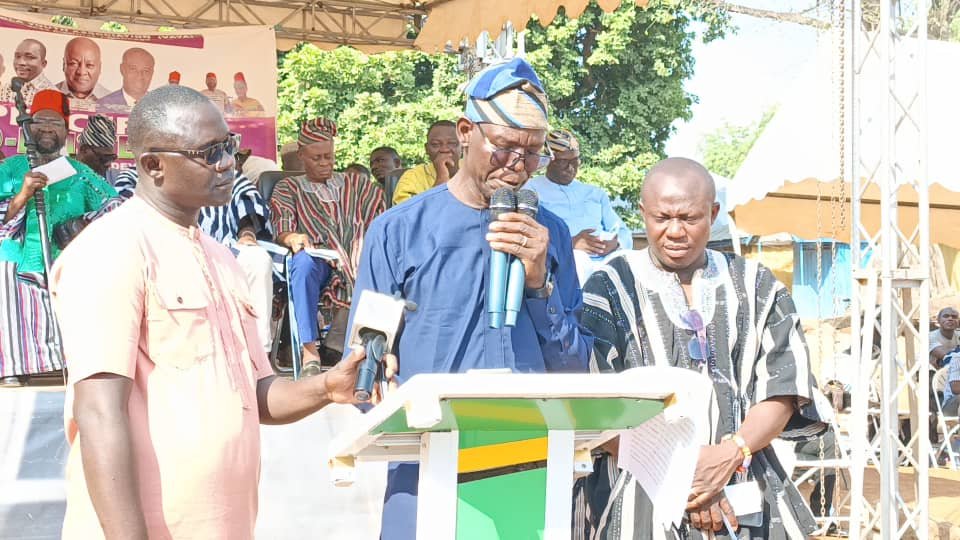
The ancient town of Bole in the Savannah Region came alive from 28th to 30th December 2025 as chiefs, youth leaders, government officials, and representatives of diverse ethnic groups converged for the Biennial Congress of the Vagla Youth Association (VAYA).
Held under the theme “Peaceful Co-existence: Youth Agents of Development,” the congress became a powerful platform for reflection, reconciliation, and renewed commitment to peace following recent conflicts that affected parts of the Savannah Region.
The grand durbar attracted high-profile dignitaries, including representative of His Excellency John Dramani Mahama, President of the Republic of Ghana, Members of Parliament, Municipal and District Chief Executives, traditional rulers, religious leaders, and youth groups from across the Savannah Region and beyond.
In his keynote address, Jacob Kuubu Ahiah, National President of the Vagla Youth Association, described the congress as a historic milestone in the journey of the Vagla, Safalba, Choruba, and Nomee/Batigee people, particularly within the Bole and Sawla-Tuna-Kalba Districts.
According to him, the gathering reflected the enduring philosophy of “Unity in Diversity,” bringing together not only the Vagla people but also allied ethnic groups with shared ancestral roots, including the Sissalas, Mos (North and South), Kasenas, Tampulmas, Chakalas, and the Ngbanya. He noted that the timing of the congress could not have been more appropriate, as the region emerges from a period of tension and seeks lasting peace.
“This is a period of calm and reflection, and we must seize the opportunity to embrace peace and strengthen peaceful co-existence among all ethnic groups in the Savannah Region,” he stated.
Mr. Ahiah urged the youth to unite against what he described as their common enemy, which is poverty, stressing that development can only thrive in an atmosphere of peace. He emphasised that the youth must not be passive observers but active promoters of peace and agents of development.
Mr. Ahiah reaffirmed that the Vagla Youth Association remains open to all recognised political parties, including both the National Democratic Congress (NDC) and the New Patriotic Party (NPP), stressing that development must transcend partisan politics.
He encouraged the youth to be politically active, informed, and responsible, rather than passive, while maintaining peace and national unity.
Speakers, throughout the congress, were unanimous in stressing that peace is the bedrock of development, warning that conflicts divert scarce resources meant for schools, hospitals, roads, and livelihoods into peacekeeping and reconstruction efforts. With the Savannah Region already among the least developed areas in Ghana, speakers cautioned that the cost of violence is simply too high.
Addressing the gathering on behalf of the Vagla Safalba Choruba and Nomee Council (VASCAN), the Chairman, Jarah Vaglikoori Bawi-Ela Baglizum, highlighted how conflicts destroy social bonds, collapse inter-ethnic marriages, erode trust, and expose children to hatred instead of hope.
He called on the youth to reject manipulation, ethnic stereotyping, and misinformation, particularly on social media platforms such as WhatsApp, Facebook, and TikTok. “Young people are both the greatest victims and the main actors in violent conflicts. If there is peace, it is the youth who benefit; if there is violence, it is the youth who suffer most,” he stated.
Throughout the congress, youth were urged to take responsibility as peacebuilders by guarding their words both online and offline, building cross-ethnic friendships, supporting inter-ethnic marriages, and refusing to be used as tools for violence.
The formation of youth peace clubs, joint sporting activities, cultural exchanges, and community clean-up exercises were proposed as practical steps to strengthen unity among communities in the Bole and Sawla-Tuna-Kalba Districts.
Traditional institutions were also recognised for their historic role in resolving disputes, conducting land cleansing, and performing pacification rites. Youth were encouraged to respect and support these traditional structures.
Delivering a heartfelt address, Abdulai Haruna Obey, on behalf of His Royal Highness Bolewura Sarfo Kutuge Feso (I), Paramount Chief and Overlord of the Bole Traditional Area, described the congress as both a moment of mourning and renewal.
While acknowledging recent disturbances that tested unity in the area, he emphasised that youth congresses must serve as platforms to reinforce traditional values, peaceful coexistence, and shared identity.
He stressed that violence has never brought development and called for youth education, employment, and inclusion in governance as long-term strategies for peace. He further appealed to government to prioritise youth employment, including recruitment into the security services, to reduce the vulnerability of young people to conflict manipulation.
North Mo Traditional Council’s solidarity message, read on behalf of Nnaa Kwaku Dapaah II, Paramount Chief of Bamboi and President of the North Mo Traditional Council, Nnaa Agbaah Jaaga III, Bampewakoora and Acting President of the Council, commended the Vagla Youth Association for sustaining unity among its people.
He urged the youth to take education seriously, avoid drug abuse and hooliganism, respect elders, and prepare themselves as future leaders. He also stressed the importance of understanding history, noting that ignorance of one’s roots often fuels conflict. On environmental sustainability, the traditional council cautioned against irresponsible mining activities, urging the youth to protect water bodies and engage in environmentally safe livelihoods.
The congress ended with a collective call for unity among ethnic groups including the Vagla, Gonja, Mo, Sissala, Brifo, Dagaaba, Kasena, Tampulma, and Ngbanya, envisioning a region where people farm without fear, investors operate confidently, and children grow up knowing cooperation rather than conflict.
Participants pledged to reject hatred, promote peace both physically and digitally, and work together to confront common enemies such as poverty, ignorance, and disease.
The event saw cultural dispalys such as Dugu, Zingor, Sator and many others.